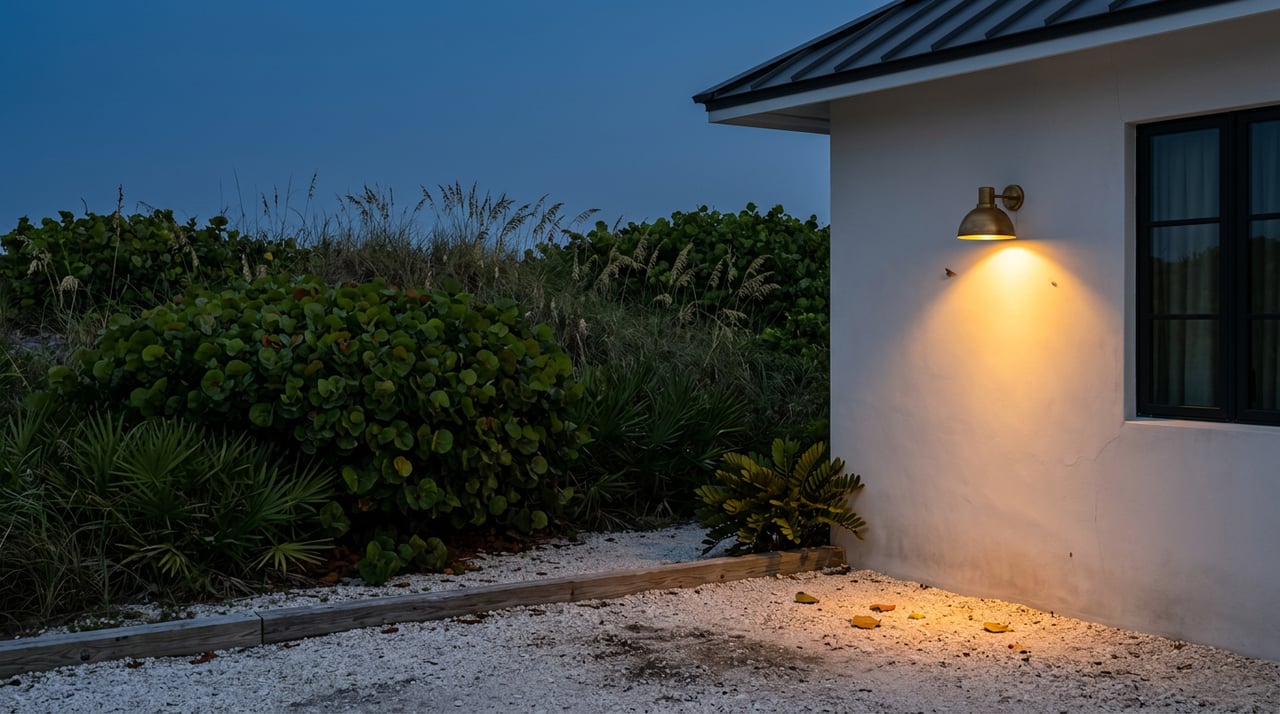
If you have walked the stretch of sand between the Big Hickory Pass and the Lee-Collier county line at sunrise this summer, you have seen the small wooden stakes and the flagging tape. You may have seen more of them than in any year you can remember. The two miles of Bonita Beach are inside their busiest weeks of the 2026 sea turtle season, and the quiet decisions being made on the porches, lanais, and second-story windows of houses several blocks inland matter more this August than they used to.
This is a resident's guide to that. Not a visitor's page. Not a checklist for renters. A read for the people who live on Little Hickory Island, along Hickory Boulevard, and in the streets behind it, because the story of Bonita Beach's hatch season has shifted, and the fix has shifted with it.
The two miles that behave differently than the rest of Lee County
Turtle Time, Inc., the nonprofit founded and run by Eve Haverfield, monitors the coastline from northern Fort Myers Beach south to the county line, plus Bunche Beach. Bonita Beach is its own segment, and it behaves unlike the beaches around it.
Last season the numbers made that plain. Across Little Hickory Island and Big Hickory Island, Turtle Time counted 187 nests for 2025, laid almost entirely by loggerheads with a single green sea turtle nest in the mix, against 381 non-nesting emergences, the "false crawls" where a female climbed the sand, aborted, and slid back into the Gulf. Midway through the same season, Florida Weekly reported 373 false crawls along Bonita Beach's two miles compared with 301 along Fort Myers Beach's seven, a ratio that is not close to normal.
The reason is a physical one. Hurricane Ian left a pronounced escarpment, a step of sand tall enough that a nesting female often cannot climb it. Haverfield's team has watched turtles reach that ledge, turn, and give up. When a loggerhead does clear it, she often nests too close to the wrack line, where a high tide can drown the clutch. Bonita Beach is producing fewer successful nests per attempt than beaches with an intact dune profile, and that means each nest that survives to hatching matters more.
The number that changed the conversation last fall
Bonita Beach had 17 disoriented nests for the 2024 season. In the Florida Weekly account of the post-season debrief, Haverfield called it the most Turtle Time had ever recorded on this stretch.
A disorientation is what happens when hatchlings, cued to move toward the brightest horizon, choose the wrong direction. On a natural beach that horizon is the moon on the Gulf. On a beach with thinned vegetation, houses gone, and new construction rising in the second and third rows back from the sand, the brightest horizon is often Hickory Boulevard.
"We have no vegetation, and houses are gone where there was a buffer. And there are a lot of new people on the beach that don't know they have to share the beach with the turtles." — Eve Haverfield, Turtle Time, Inc.
Two things follow from that. First, the properties triggering disorientation are no longer only the Gulf-front rentals that everyone in Bonita Springs assumes are the problem. Sanibel-Captiva Conservation Foundation biologists have told regional press they now see sky glow from Cape Coral, Bonita Springs, and Naples reaching Sanibel's nesting beaches, which suggests inland lighting patterns from our own city travel farther than most homeowners think. Second, on a beach that has already thinned to expose more of what sits behind it, the second row of homes has effectively become the front row for a hatchling looking for the brightest horizon.
What the City actually asks of residents from 9 p.m. to 7 a.m.
Bonita Springs adopted an updated Sea Turtle Conservation Code, Ordinance 23-08 (Section 7-52), on June 21, 2023. The nesting window runs May 1 through October 31, and the lighting rules apply from 9 p.m. to 7 a.m. every night in that window. The City's own guidance page is short and worth reading in full. The concrete asks:
- Shut off or shield any light visible from the beach. If a fixture points down and cannot be seen from the sand, it is generally fine. If it can be seen, it is not.
- Close drapes and blinds after dark on any window that faces the Gulf, including second- and third-story windows.
- If exterior lighting is necessary, switch to long-wavelength amber, orange, or red LEDs at the lowest wattage that works. The old 25-watt yellow "bug" bulbs are still permitted but are no longer the recommendation.
- Keep flood lights and motion detectors either compliant by design or fitted with temporary shields during nesting season.
- No flashlights, fishing lanterns, or fires on the beach itself. If you must use a light, use red.
Reports of a violation go to Bonita Springs Community Development, Environmental Sciences Section, at 239-444-6142. That number is worth saving in your phone alongside FWC's stranded-turtle line, 1-888-404-FWCC, which is the one you use if you find an injured, dead, or spray-marked turtle on the sand. Spray paint on a shell means the animal has already been documented, and the dispatcher will want to know.
The second-row math nobody explains
Here is the piece that gets left out of the standard nesting-season write-up.
Before Ian, a two-story house set back from the dune had a natural filter in front of it, a wall of sea grape, seagrape, cocoplum, and Australian pine. A lamp burning behind an interior window on that second story simply did not project onto the sand. That is no longer reliably true along the Bonita Beach corridor. Sections of the dune line are still healing, and in places the sight line from a hatchling on the wrack up to a bedroom window three parcels inland is nearly clear. This is why Turtle Time and City staff have been asking residents on the interior side of Hickory Boulevard, not only the Gulf-front owners, to draw their blinds after nine. It is not a symbolic request. It is a response to a corridor that changed.
For anyone still keeping older halogen or full-spectrum LED fixtures on the seaward side of the house, this is the season to switch. Fixtures certified to Florida Fish and Wildlife Conservation Commission amber standards are widely stocked at hardware retailers along Bonita Beach Road and at builders' suppliers in Bonita Springs. Ordinance 23-08 also folds sea turtle lighting standards into the building-permit review for new construction and substantial renovation on Little Hickory, Big Hickory, and Black Islands, which is documented on the City's Community Development site. If you are already in a renovation cycle, ask your contractor to spec compliant fixtures at design, not after final inspection.
What August actually looks like on the sand
The first Bonita Beach nest of the season last year was reported by Turtle Time in late April. Loggerhead incubation runs roughly 50 to 60 days, which is why late July and August are the busy hatching weeks. If you take an early walk between the county line and Little Hickory Pass this month, expect to see nests in three states: freshly staked, hatched with faint tracks fanning toward the Gulf, and, three days after hatching, a small cordon around a Turtle Time volunteer excavating to record the hatch count and rescue any stragglers.
A short list of resident conventions that the Bonita Beach Club community summarizes cleanly on its beach access page, and that apply up and down the two miles:
- Use the designated dune crossovers. The dune is not a shortcut.
- Move beach chairs, umbrellas, and toys behind the dune line at sunset. Anything left on the sand becomes an obstacle for a female climbing at 2 a.m.
- Fill any hole you or your kids dug before you leave. Hatchlings fall in.
- If you see a marked nest, give it at least ten feet.
- If you see a nesting turtle, stay behind her and out of her sight line. No flash photography. No walking around to the front.
- If you see a hatchling on the sand in daylight, do not touch it. Call FWC.
None of this is new. What is new is the number of households along Bonita Beach for whom this is their first full summer as full-time or seasonal residents. The dune profile keeps changing. So does the neighborhood.
Why residents are the story this year
Lovers Key State Park just north of us posted 33 hatched nests out of 40 for 2024, one of the strongest ratios in the region. That park has professional staff, controlled access, and no residential lighting behind its dune line. Bonita Beach cannot replicate the first two, but it can control the third. The disorientation number that jumped last year is the one variable the community itself can move by October 31. It is a rare case in Southwest Florida where doing very little, drawing a blind, swapping a bulb, walking to the beach without a phone flashlight, produces a visible result inside a single season.
We spend a lot of time at The Dellatorè Real Estate Company talking about what makes Bonita Springs different from the communities up the coast. The stewardship instinct of the residents on Little Hickory Island is one of those things, and it is on full display for the next ten weeks. If you would like to compare notes on the corridor, the escarpment, or a beachfront property's lighting compliance before nesting season closes, we're always around. Get a Free Home Valuation whenever you're ready.